A Script Is Not a Blueprint for One Performance
Learn how to interpret stage directions, preserve essential cues, and adapt staging choices so the audience can follow the play in your venue.
A stage direction can carry essential information without dictating every movement or design choice. To interpret stage directions well, identify what the audience must understand, then find a workable way to make that clear in your production.
This distinction matters whether you are directing, designing, or reading a script before rehearsal. Treat each direction as information to interpret, not an order to obey blindly or an obstacle to remove. Ask what the moment must communicate to the audience.
What does the direction actually do?
Stage directions serve different purposes. A direction may mark an entrance, specify a sound the audience must hear, describe an action that changes the plot, or suggest how a character behaves. Other directions may offer a visual image without making that image essential.
Read the scene around the direction. Ask what changes if the action is delayed, moved, or presented another way. If the audience would lose a necessary fact or misunderstand who has power, the cue is doing structural work. If the scene still makes sense with a clear alternative, the detail may be open to interpretation.
- Check the event: If a later response depends on an action, preserve that action or its clear equivalent; otherwise, adjust the staging to fit the scene.
- Check the information: If later dialogue depends on a sound, object, or physical change, make it legible; if not, consider a simpler way to stage it.
- Check the behavior: If a direction such as “hesitates” shapes the character’s choice, preserve the hesitation; if its exact form is unspecified, try a pause, a failed gesture, or a change in eye contact.
- Check the image: If a room or prop is needed to understand the relationships and events, retain it or find an equivalent; if not, choose an image that fits your venue.
- Check the object’s use: If a chair becomes the focus of an action, such as hiding or refusing to share it, keep a usable chair; if it is only background, substitute or remove it as the production requires.
- Check the next beat: If removing a direction makes the following line or event confusing, restore the cue or add a clear replacement; if the transition still reads, the change may work.
These are working distinctions, not fixed categories. A chair may be decorative in one scene and essential in another because a character hides beneath it or refuses to share it.
Which situation are you in?
Sort the staging question by the work it does. The same printed direction can call for different treatment in a small studio, a school production, or a large theater, but the production should be able to explain its choice in terms of the scene.
If the plot depends on the action, what should you preserve?
Preserve the audience’s ability to follow cause and effect, even if you change the mechanics. If a letter is discovered, the staging must show who finds it and why that discovery matters; the letter need not be on a particular table unless the text makes that location important.
If the direction describes mood, how much freedom do you have?
You can shape mood through acting, light, sound, or spacing, provided the scene’s emotional turn remains readable. A “cold” room might be conveyed by rigid posture and a hard sidelight rather than a literal draft or visible frost.
If the venue cannot support the direction, what should change?
Keep the intended audience experience and adapt the means. A printed thunder cue might become a low drum roll or a sudden shift in the actors’ behavior, as long as the sound or threat still registers when the scene needs it.
If the text leaves a gap, who decides what fills it?
The production team decides, using the play’s circumstances, the available performers, and the space. Make the choice specific enough for actors and designers to work from, then avoid treating that decision as if the script had settled it for every production.
How can you tell a cue from a prescription?
A cue points to something the audience must perceive or the actors must respond to. A prescription specifies one way to produce that effect. Keep the cue’s purpose in view while testing whether the prescribed method is necessary.
For instance, a direction that calls for a door slam may signal a rupture, interrupt a speech, or alert someone in another room. The slam itself may be replaceable, but the interruption or response may not be. If you soften the sound, make sure the next beat still follows logically.
Watch for directions that carry information about timing. “Before she answers” can establish that a character has heard the question and chosen silence. Moving the pause after the answer changes the behavior, not merely the rhythm. Timing is often part of the action even when the physical gesture is flexible.
How should the team test an interpretation?
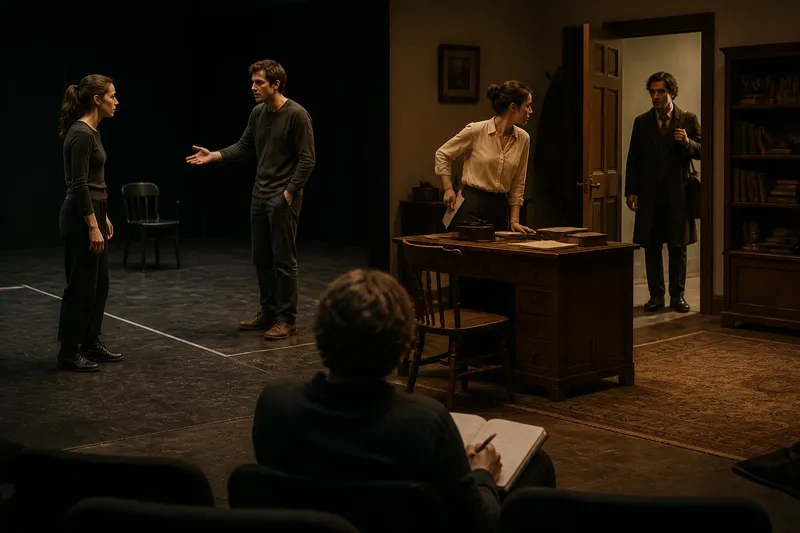
Try a choice in the room and judge it by what becomes visible and understandable. Put the actor in the space, run the moment, and ask what an audience can infer from the action.
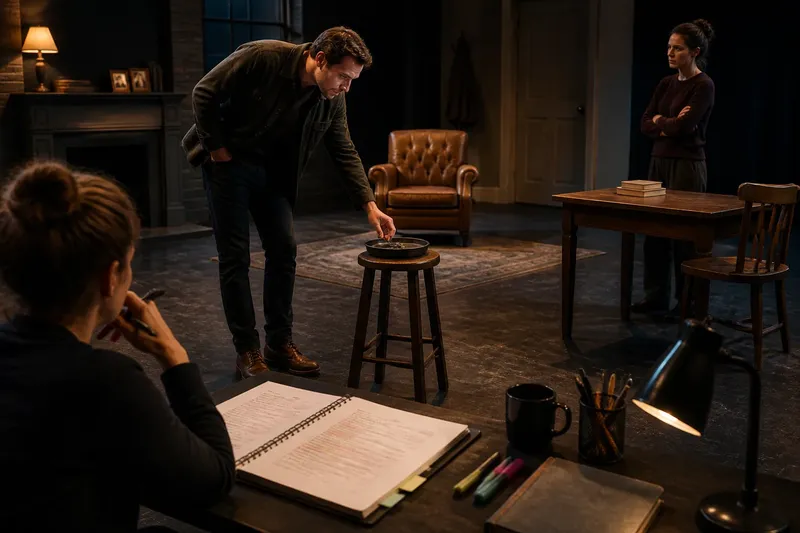
Say you are directing an invented scene with these hypothetical starting details: a character must notice a missing key, the script places it on a mantel, and the rehearsal room has no mantel. Put a small tray on a stool, have the actor reach for the key and find the tray empty, then run the next line. If the discovery and its consequence are clear, the substituted surface serves the cue. If not, add a visible search or change the actor’s action, then run the moment again and check whether the audience can follow the loss.
Use these checks after a run:
- Check the change: If a viewer can identify what changed in the scene, keep the action; if not, clarify the event through movement or a visible object.
- Check the actor’s reason: If the actor can play a specific reason for a movement or pause, retain it; if not, connect it to a character’s immediate goal or try another choice.
- Check the relationships: If the staging supports the relationships established by the dialogue, keep it; if it contradicts them, revise the actors’ spacing or focus.
- Check the design: If a design element clarifies the action, retain it; if it competes for attention, simplify or reposition it.
- Check the next beat: If the next line or event follows naturally, keep the transition; if not, restore a cue or add a clearer action.
- Check a contrasting version: If a quieter or more conspicuous entrance makes the scene clearer, use that version; if neither works, revisit what the audience needs to know.
Keep the version that communicates the play’s action with the least confusion, not simply the one that resembles a printed picture.
What should you do when the script and the room disagree?
First identify the conflict precisely. “We cannot do the direction” is too broad. Say whether the problem is an unavailable object, an unsafe movement, an unclear transition, a cast limitation, or a mismatch between the described setting and the venue. Then preserve the dramatic function while changing the practical arrangement.
For a prop, consider whether an actor’s gesture can carry the information instead. For a location, use levels, light, or the actors’ focus to distinguish areas. For a crowd, consider whether a few performers can suggest a larger public through coordinated attention and sound. Each substitution should answer a specific need rather than become a general excuse to ignore the text.
When a direction raises a rights, safety, or production-permission question, check the relevant script edition, contact the rights holder or venue staff, and consult a qualified professional when appropriate. Keep that separate from artistic interpretation: a creative choice does not settle an external restriction.
How can you respect the playwright without copying one staging?
Respect the play by making its actions and relationships legible, not by treating every stage direction as sacred scenery. At the same time, do not discard a direction simply because it is inconvenient or unfamiliar. Ask what the instruction helps the audience notice, then find a workable means to preserve that attention.
A script is not a blueprint for one performance. Turn that idea into a concrete decision: retain what the scene needs, interpret what the production can shape, and test the difference in rehearsal. When you revisit a staging choice, return to the audience’s view. If the essential event still reads and the actors can play the moment truthfully, the production has made the script its own without pretending the script said less than it did.