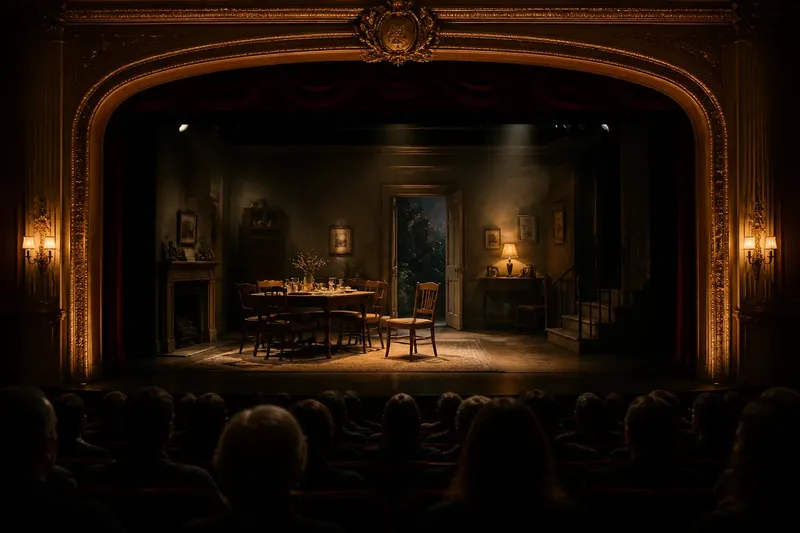
Bare Stage or Built Room: Two Ways to Direct Attention
Bare stage or built room: learn how each setting directs attention, then choose the theatrical details your audience needs to notice and interpret.
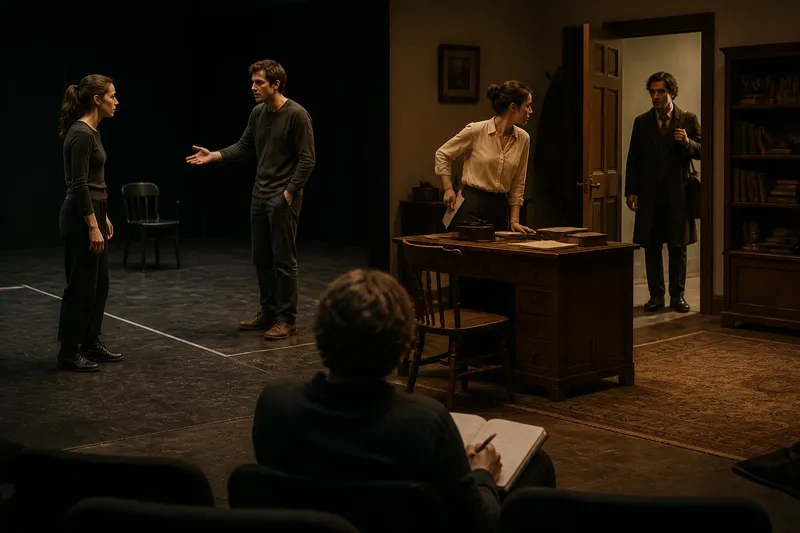
A bare stage or built room tells the audience what to watch before an actor speaks. An open floor can make a gesture, a group, or a change of focus carry the scene; a furnished setting can give objects and spatial relationships their own meaning. Choosing between them is less a matter of style than of deciding which information should be visible and how the audience should receive it.
Use this weeklong design routine to make that decision with the script, rehearsal room, and available materials in view. The aim is not to decorate a play or strip it down on principle. It is to shape the audience’s attention, then check whether the stage picture supports the action.
What should the audience notice first?
Begin with a scene, not a scenic concept. Read a short passage and mark what a spectator needs to understand at each turn: who has power, what has changed, what is hidden, and which details matter later. Distinguish necessary information from atmosphere. A room can feel crowded without every piece of furniture being essential; an empty floor can feel exposed without requiring the actors to explain the absence.
Make a simple two-column note. Put each piece of information in one column and the stage device that might convey it in the other. “The character is trapped” might be conveyed by a narrow doorway, a tightly grouped ensemble, or a visible boundary on the floor. “The letter matters” might call for a readable, handled object—or for the audience to see the actor conceal it. The device should help the spectator read the event, not merely illustrate a line.
On the first day, gather the director, set designer, stage manager, and a few performers around the script. Agree on the scene’s most important shifts in attention. Keep the list short enough to use in rehearsal. If the team cannot say what a setting detail communicates, leave it undecided rather than treating it as a requirement.
What does a nearly bare stage make visible?
A sparse setting gives the performers and their arrangements more visual weight. A change in distance can register as rejection or alliance. A single chair can become a seat, a barrier, or a place no one dares occupy. Because there are fewer fixed details competing for notice, audiences may attend more closely to bodies, speech, rhythm, and shifts in group behavior.
That openness also asks more of the production. Performers need clear, repeatable choices: where they stand, how they cross the space, and what changes when they move an object or address someone across the floor. The stage picture can become vague if every location is suggested in the same way. Choose a few consistent conventions, such as a bench always marking a public waiting place or a pool of light distinguishing a private conversation, and let them do recognizable work.
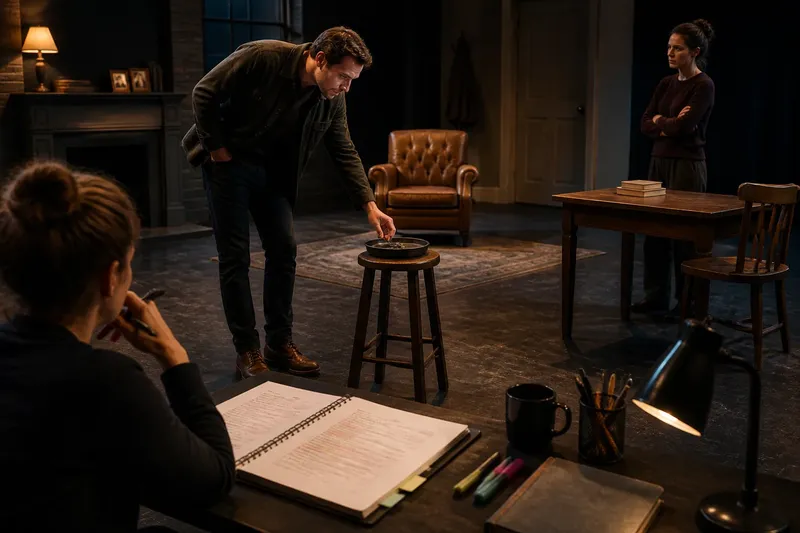
On the second day, rehearse one scene with only the existing stage, a few chairs, and a length of tape to suggest a boundary. Ask observers to describe what held their attention and what they understood about relationships. Do not ask whether the scene looked “finished.” Ask whether the openness made the intended information legible, and note where spectators had to guess for reasons the play did not intend.
What does a built room add to the scene?
A detailed setting gives the audience a network of visible clues. A doorway can make entry and surveillance part of the action. A table can separate people who share a room, while a packed shelf can suggest routines or priorities. The room may establish social conditions before anyone states them, and objects can carry meaning from one scene to the next.
Each added feature also competes for attention. A realistic room invites spectators to inspect its contents, so a conspicuous object can seem important even if the play never returns to it. Furnishings may constrain movement, obscure faces, or make a transition harder to read. Choose details that serve a specific beat, establish a useful relationship, or give an actor an intentional action. Treat the rest as optional.
On the third day, bring in a rough arrangement using rehearsal furniture or clearly temporary stand-ins. Place only the pieces that affect blocking or interpretation. Run the scene, then ask observers to name the details they remember and why. If they focus on a decorative object while missing a meaningful exchange, reconsider the object’s prominence or position. If a doorway clarifies who is watching whom, preserve that relationship as the design develops.
How can you compare the two choices fairly?
Use the same scene, performers, and basic movement for both arrangements. Otherwise, it is hard to tell whether a shift in attention came from the setting or from a changed performance. On the fourth day, run the scene first with the bare arrangement, then with the rough room. Keep notes on observable responses rather than asking which version people like more.
- What did spectators look at during the scene’s main turn?
- Which relationship or change did they describe without prompting?
- Did any object attract attention without helping the action?
- Did the open space make a location or boundary confusing?
- Could performers use the arrangement without interrupting the scene’s flow?
Say you are staging a scene in which a character tries to hide a document from a visitor. In the bare version, the actor’s concealed hand and the visitor’s changing position might make the secret readable. In an invented built-room version, a desk and doorway could show where the document is hidden and who can see the entrance. If observers miss the concealment in the first arrangement but track it in the second, that gives the team a concrete reason to retain the desk—not a reason to furnish the whole stage.
What should you do during the rest of the week?
On the fifth day, revise the arrangement that best serves the scene’s essential information. Keep useful features, remove distractions, and adjust the actors’ routes so the setting supports rather than dictates their choices. If the two versions reveal different strengths, borrow selectively: a mostly open floor may still need one door, table, or platform to make a crucial relationship legible.
On the sixth day, test transitions and moments when attention must move quickly. Ask the stage manager to track what must be carried, reset, or shifted, and watch from several audience positions in the room. A detail that reads clearly from the center may disappear from the side; a scenic change that looks simple on paper may draw attention away from the next event. Keep the trial practical and focused on what spectators can see.
On the seventh day, make a short design note for the next rehearsal: what the setting communicates, which objects actors use, what should remain visually quiet, and which questions still need an answer. This gives the designer a clear brief without locking the production into a finished look too early. Check the venue’s access, storage, fire, and scenic requirements against its instructions and applicable local rules before committing materials or layouts.
Which arrangement fits the information the play carries?
Choose the bare stage when the scene’s strongest information lies in performance, spatial relationships, or an audience’s active interpretation. Choose a built room when the physical environment supplies clues the audience must see, or when the play’s action depends on specific objects and boundaries. A mixed approach can work when the setting needs a few precise anchors but not a complete interior.
These are not fixed categories. A spare stage can feel controlled if its boundaries are exact; a dense room can feel open if the actors command clear paths through it. The useful question is not how much scenery a production can afford or how realistic a room should look. Ask which details earn the audience’s attention, and what that attention lets them understand.
What questions help settle the choice?
Does a bare stage mean there is no set?
No. The floor, light, costumes, sound, and actor movement all shape the stage picture. “Bare” usually means the production relies on few fixed scenic elements, not that the space communicates nothing.
Can a detailed room still feel theatrical?
Yes. A room can use selective or exaggerated details rather than copying an everyday interior exactly. The design feels theatrical when its visible choices shape how the audience reads the action.
How do you stop set dressing from distracting the audience?
Give each prominent object a reason to be visible, such as supporting an action, establishing a relationship, or returning later with new meaning. Move or simplify objects that draw the eye without helping spectators follow the scene.
Can a production combine a bare stage and a built room?
Yes. Start with the minimum scenic elements that clarify the action, then add only what the scene needs. A single doorframe, table, or raised platform can establish a useful condition while leaving room for performance to carry the rest.
For a bare stage or built room, the most useful design note is a sentence that names the audience’s task: watch the shifting alliances, notice who can see the entrance, or follow the object changing hands. Keep that sentence beside the rehearsal notes as scenery develops. If a proposed detail makes that task clearer, consider it; if it asks spectators to look elsewhere, let it go.