How the Proscenium Arch Frames a Stage
Learn how the proscenium arch frames stage action, directs your attention, and gives you practical clues for reading a production from your seat.
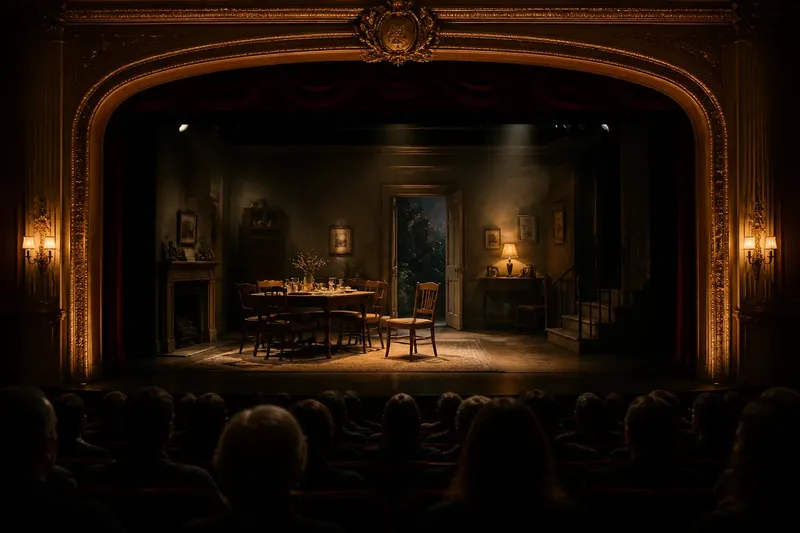
A proscenium arch gives you a clear front-facing view of the stage, but it does not make every production look like a picture. The proscenium arch shapes what you can see and how a production can direct your attention.
How does a proscenium arch frame the stage?
The proscenium is the architectural opening between the auditorium and the stage. The arch may be decorated, plain, or nearly invisible; the defining feature is the framed opening and the audience’s position on one side of it.
That arrangement differs from a thrust stage, where the playing area extends into the audience, and an arena stage, where spectators surround the action. A proscenium audience generally shares a forward-facing view. Curtains, scenery, and lighting can use the opening as a boundary between the auditorium and the world of the play.
Calling the opening a “picture frame” describes a viewing effect, not a claim that the stage is a still image. Actors move, scenery changes, and the production can challenge the boundary by addressing the audience or exposing how the scene is made.
What does the frame change for an audience?
A fixed viewing direction helps a production arrange faces, objects, and entrances for spectators seated across the auditorium. A doorway at the back can suggest depth, while a table placed at an angle can make the actors’ faces easier to see. The same arrangement may look different from seats at the side, where an object can block a view or a face can turn away.
The frame can also encourage a sense of separation. Actors may behave as if they are alone in a room, although the audience can see them. Direct address changes that convention: a performer who looks outward or speaks to the house makes the audience’s presence part of the scene.
Imagine a director staging a family dinner with an empty chair near the front of the stage. The actors glance toward it but never explain it. In that invented situation, you might infer that the absent person matters; if the glances are hard to see from your seat, the production may instead leave the chair’s significance uncertain.
How can you read the stage from your seat?
Use the frame to notice the production’s choices, not to assume a particular style. Before the action begins, look at the opening, the curtain, and the visible edge of the set. During the scene, check what the actors and designers emphasize.
- Check the stage edges: If actors use the wings as ordinary exits, read them as routes out of the scene; if they pause or hide there, watch for an implied boundary or concealed action.
- Check sightlines: If a face or object is clearly visible from your seat, follow how the production uses it; if another figure blocks it, shift attention to the action you can see rather than assuming the detail was meant for every seat.
- Check stage depth: If an actor at the back remains visible and prominent, notice how the staging sustains attention there; if the actor is obscured, rely on dialogue or movement elsewhere to follow the scene.
- Check direct address: If a performer looks or speaks toward the audience, treat the audience as part of that moment; if the performer avoids the house, read the scene through the characters’ relationship instead.
- Check offstage sounds: If a sound comes from beyond the set, consider what unseen space it establishes; if its source remains unclear, keep that uncertainty in mind rather than assigning it a definite cause.
- Check the curtain and scenery: If a change is visible, notice how the production makes its construction part of the event; if it is concealed, focus on the new arrangement revealed when the view opens.
These observations separate the architecture from the choices made inside it. A proscenium stage can hold a realistic room, an abstract landscape, a bare floor, or visible theatrical equipment. The opening sets a viewing arrangement; it does not dictate the acting style or design.
What do playgoers often ask about the proscenium arch?
Is a proscenium arch the same as a picture frame?
No. The arch is part of the theater’s architecture, while “picture frame” describes the bounded view it can create. Unlike a still picture, a stage changes as performers move and scenes unfold.
Does a proscenium production have to look realistic?
No. A proscenium can frame a realistic room, an abstract setting, or an exposed stage with equipment in view. The audience faces the action from one side, but the production determines its visual style.
Why do actors sometimes speak to the audience?
Direct address makes spectators part of the theatrical event. Depending on the moment, it can invite them to share a joke, consider a claim, or witness a character’s appeal.
Can a proscenium performance feel intimate?
Yes. A quiet exchange, a visible change in expression, or a focused pause can hold attention across the auditorium. The frame establishes distance, but the performance can make a moment feel immediate.
How does the proscenium arch help you watch?
The proscenium arch gives you a shared direction of attention, while the production decides what belongs inside the frame and what remains beyond it. At your next performance, choose one visible object and follow how actors, light, or scenery draw attention to it; if its meaning stays unclear, note that uncertainty too. The frame is useful not only for spotting what the production shows, but for noticing how it guides your view.